
Prepared by Adv. Meir Liberman · Published 24 August 2026
The process in one paragraph
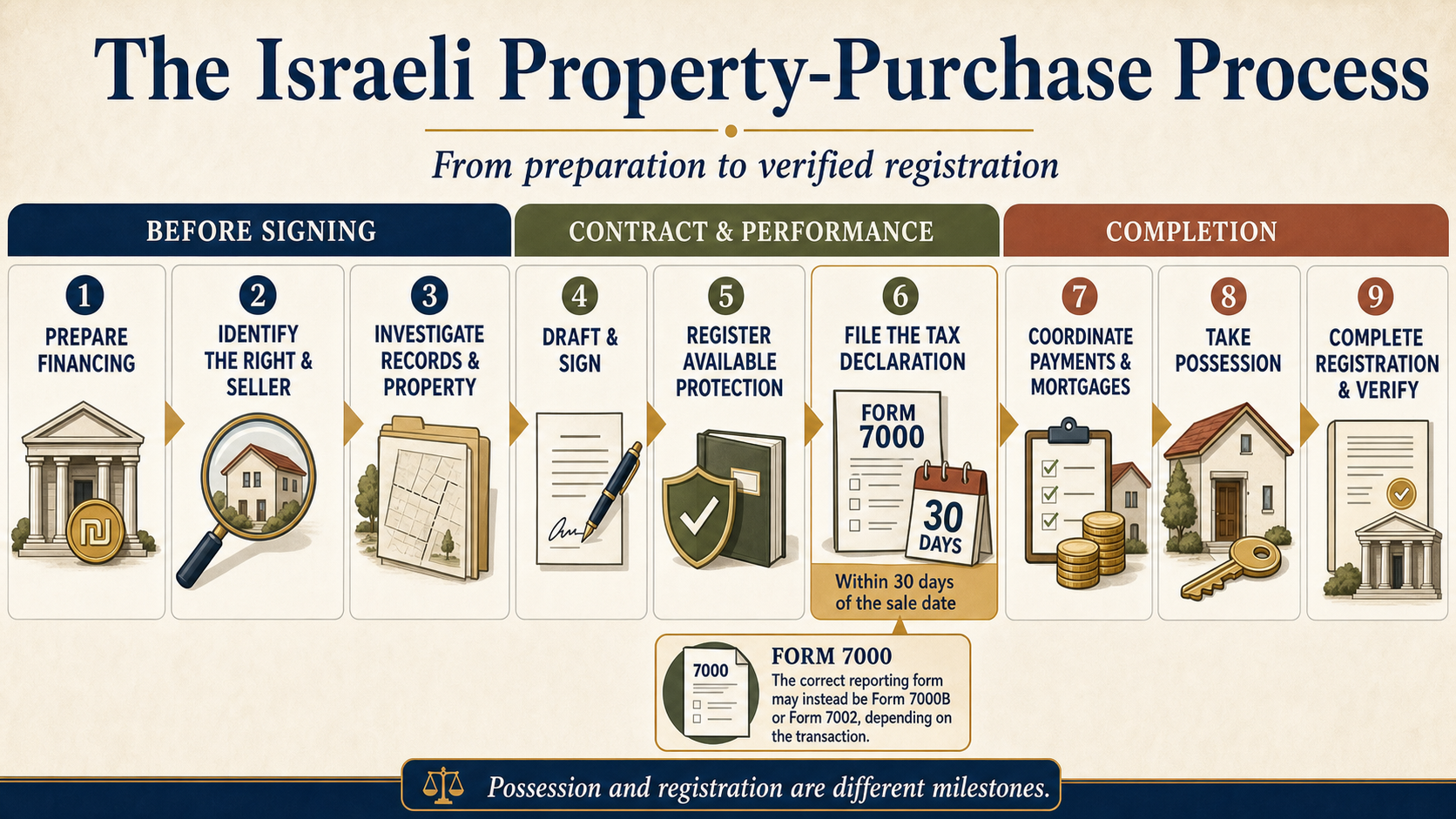
An Israeli residential purchase is not one event. It is a sequence in which the buyer first establishes financing capacity, identifies the right and seller, investigates the legal and physical property, negotiates an agreement that responds to those findings, registers the available protection, reports the transaction for tax, makes payments against defined milestones, receives possession, and finally registers the purchased rights.
The Land Registry, commonly called the Tabu (טאבו), appears at both ends of that sequence. A current extract may be examined before signing to identify registered rights and encumbrances. Registration of the buyer is generally the intended endpoint. Between those two points, the parties must create and perform the transaction.1, 2
That distinction is the organizing principle. The Tabu records rights. It does not negotiate the contract, approve the mortgage, inspect the apartment, calculate the parties’ taxes, obtain municipal certificates, discharge the seller’s loan, or decide whether the apartment matches its permit.
Before making a commitment: financing and source of funds
The process should begin before the buyer signs a contract or pays a deposit. A buyer who needs a mortgage should obtain an approval in principle (ishur ekroni, אישור עקרוני) and understand what it does and does not mean.
Bank of Israel materials describe an approval in principle as a bank’s preliminary willingness to lend based on information supplied by the borrower.5 It is not final approval of the apartment. The bank may still require an appraisal, legal documents, satisfactory security, insurance, and compliance material. The property may be worth less than the agreed price or may present a registration or planning problem that affects the bank’s decision.6
Financing and contract timing therefore cannot be separated. The contract fixes payment obligations. The buyer bears the risk of meeting them unless the agreement gives a relevant protection. A preliminary conversation with a bank should not be treated as a financing condition that the seller has accepted.
For money arriving from abroad, the receiving bank should be approached before the payment schedule is fixed. The bank may request evidence of the source of funds, transaction documents, tax material, identification, or explanations concerning the transfer. Banks differ in procedure and may ask follow-up questions. Currency conversion and international transfer time should be built into the practical timetable rather than assumed to occur instantly.
Step 1: identify the property, the right, and the seller
The first legal question is not simply whether the apartment “has Tabu.” The question is what right is being sold and where it is recorded.
For an apartment registered as an independent unit, the lawyer will ordinarily obtain a current Land Registry extract using its gush, helka, and tat-helka identifiers (גוש, חלקה ותת-חלקה). The apartment number in the building is not necessarily the same as its Tabu subparcel number.2
Other properties are administered through the Israel Land Authority (Rami, רמ״י, רשות מקרקעי ישראל) or recorded by a registering company (chevra meshakenet, חברה משכנת). Some sellers hold a contractual chain of rights but are not yet the registered owner. These are not merely different names for the same document. Each system requires its own current records and transfer path.3
The seller must also be identified and matched to the operative record. Joint owners, heirs, companies, spouses, attorneys under a power of attorney, guardians, estate administrators, receivers, and other special sellers can require additional signatures, proof of authority, or approval. The answer must be established before the agreement assumes that one person can transfer the property.
Step 2: investigate the legal and physical property
Due diligence is not one search. It is several investigations that answer different questions.
Rights and registration
The rights record is checked for the registered or recorded holder, the property description, mortgages, cautionary notes, attachments, easements, and other relevant entries. Where the seller is not registered, the chain of agreements and assignments must be reviewed. Parking, storage, roofs, and gardens must be traced through the legal documents rather than accepted from the advertisement or physical use alone.
Planning and permits
Registration does not prove that the apartment was built or altered lawfully. The Planning Administration provides a national database for plans, applications, appeals, meetings, and decisions.4 Municipal GIS systems may add useful orientation. Neither replaces the official building file, permit, approved plans, or a physical comparison by an appropriate professional.
Municipal access varies. Some documents are online. Others require a formal request. Files may be incomplete. If walls were moved, a balcony enclosed, a roof used privately, an apartment divided, or the visible property does not match the documents, an architect, engineer, appraiser, or surveyor may be required.
Taxes, debts, and transaction costs
The buyer’s purchase tax (mas rechisha, מס רכישה) and the seller’s land appreciation tax (mas shevach, מס שבח) are different liabilities. The agreement cannot safely treat “tax” as one undifferentiated item. The buyer’s classification, other property interests, immigration status, family circumstances, and transaction structure can affect the result. Current rates and reliefs belong in a dedicated tax analysis, not a general process article.
The investigation should also identify municipal charges, betterment levy risk, broker fees, legal fees, appraisal and inspection costs, financing expenses, exchange costs, renovation, and registration expenses. Legal liability for a charge, contractual allocation of its cost, and the document needed for registration are separate questions.
Occupancy and possession
The buyer should know who occupies the apartment and under what right. A tenant, family member, licensee, or holdover occupant can change the possession arrangements. The agreement should not promise “vacant possession” without confirming what must happen to deliver it.
Step 3: make the contract respond to the investigation
The contract is not the starting point. It is the legal response to what was found.
If the seller has a mortgage, the payment mechanism must provide a route to discharge it. If registration is incomplete, the agreement must require the chain documents and institutional cooperation needed for transfer. If a planning discrepancy exists, the parties must decide whether it will be corrected, accepted, priced, conditioned, or treated as a reason not to proceed. If certificates will arrive after possession, the agreement may need a retention mechanism and enforceable document obligations.
The agreement ordinarily addresses the property and attached areas, price, payment dates, taxes and expenses, representations, existing security, buyer financing, possession, condition, breach, remedies, powers of attorney, retained documents, and final registration. The particular clauses depend on the transaction. A generic template cannot decide which risk must be addressed.
Accordingly, a zichron devarim (זיכרון דברים), letter of intent, accepted offer, or informal signed memorandum can be dangerous. A short document may create obligations before the investigation, tax analysis, and financing plan are complete. The label does not answer whether it is binding.
Step 4: sign, then register the available buyer protection
After signing, an eligible Tabu transaction commonly proceeds to registration of a cautionary note (he’arat azhara, הערת אזהרה). The official service covers notes concerning commitments to carry out or refrain from a transaction and consent requirements under the Land Law.7
The note matters because it places the undertaking in the registered record and affects later inconsistent dealings. It is not ownership. It does not cure an invalid agreement, lack of seller authority, prior encumbrance, illegal construction, physical defect, or unpaid tax. It is one part of the protection structure.
Where the right is maintained by the ILA or a registering company, the available protection may take another form, such as an institutional undertaking, recorded notice, document deposit, or bank security arrangement. The contract and payment sequence must fit the actual system.
Step 5: report the transaction and arrange tax payment
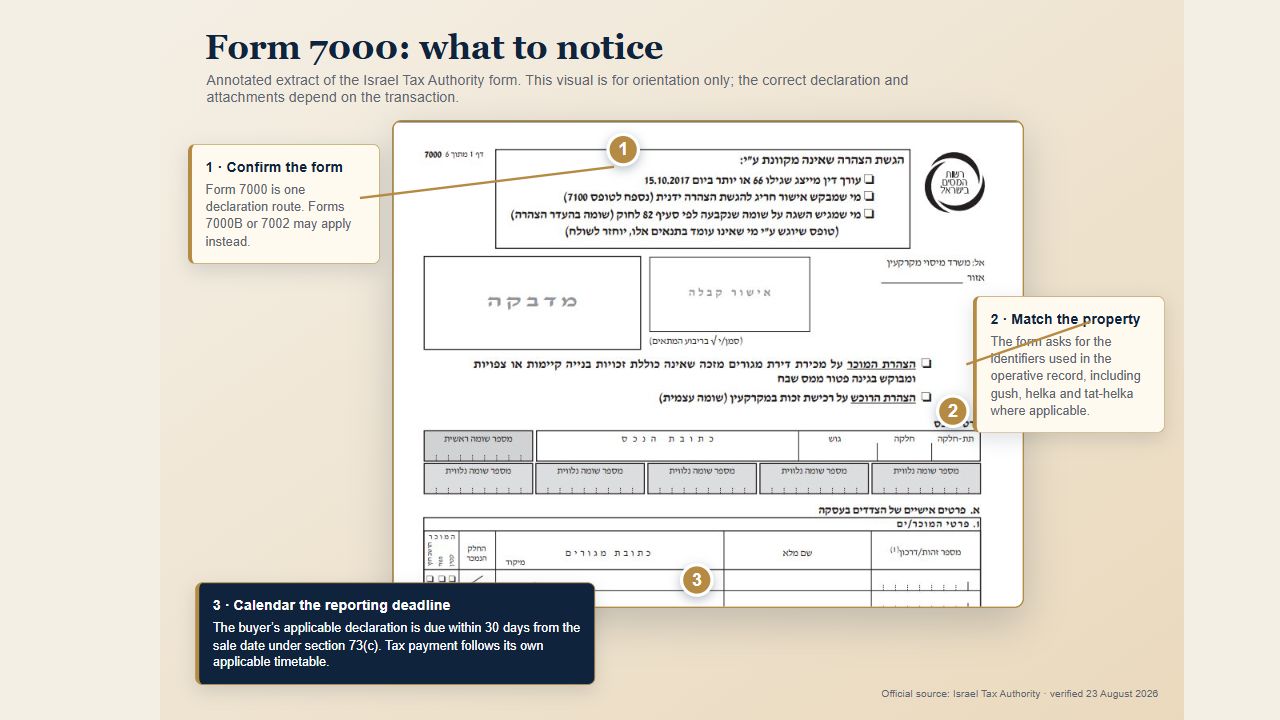
The declaration includes the right, transaction, consideration, and purchase-tax self-assessment. The correct form, online procedure, and supporting documents depend on the transaction and should be confirmed for the particular purchase.9, 10
Reporting and paying are related but distinct. The Tax Authority provides separate payment routes for purchase tax, land appreciation tax, and related liabilities.11 Tax clearance also matters later because the registration package may require certificates confirming that the relevant tax requirements have been satisfied.
Step 6: coordinate mortgage performance and staged payments
If the seller has an existing mortgage, part of the purchase price may be directed to the seller’s lender under a current payoff or undertaking document. If the buyer is borrowing, the buyer’s bank will require its own documents and security. For registered property, that may include registration of a mortgage; the Ministry of Justice maintains a separate mortgage-registration service.8
The two banks are protecting different interests. The seller’s bank wants repayment before releasing its security. The buyer’s bank wants enforceable security before or when it releases loan funds. The buyer’s lawyer coordinates the legal structure, but the bank does not become the buyer’s legal representative.
Payments are therefore commonly made in stages. The exact percentages are contractual, not a nationwide statutory formula. The underlying logic is that each significant payment should correspond to a reduction in risk, a document, or a milestone. Examples include registration of the buyer’s protection, delivery of a seller-bank undertaking, discharge of existing security, delivery of possession, deposit of tax or municipal documents, and readiness for final registration.
An unsafe schedule requires most of the price before the buyer has received equivalent protection or before the funds needed to remove a prior mortgage have been controlled.
Step 7: possession is important, but it is not final registration
On the contractual possession date, the buyer may receive the keys, inspect the agreed condition, record meter readings, transfer utilities, document fixtures, and confirm whether the property is vacant. A written possession protocol can record what happened. Its content depends on the agreement; there is no single universal government form.
Possession and ownership should not be collapsed into one event. The buyer can take physical control while tax, municipal, mortgage, or registration documents remain outstanding. The agreement should state what is due at possession, what can remain afterward, which funds or documents are retained, and who must complete each outstanding act.
Step 8: collect certificates and register the legal result
Final registration is document-driven. In an ordinary registered sale, the package may include signed transfer instruments, tax certificates, the municipal certificate required for the transfer, release or cancellation of the seller’s mortgage, powers of attorney, identity or corporate documents, and any additional approval required by the title and transaction.12, 13
The exact list is not universal. ILA property, registering-company property, inherited rights, corporate sellers, foreign documents, and incomplete condominium registration all change the route. Municipal certificate procedures, fees, validity periods, and processing times also vary.
Once the requirements are satisfied, an application to register the sale can be filed for eligible Land Registry property. The Ministry of Justice describes that service as the route for registering a transfer of ownership in land already recorded in the Land Register.12 The registrar examines whether the submitted registration package meets the applicable legal and procedural requirements. The registrar does not repeat the buyer’s full contractual, planning, physical, or tax due diligence.
Step 9: verify the result
The process should end with evidence, not assumption. For a Tabu transaction, a fresh extract should be obtained to confirm that the buyer is registered as intended and that entries meant to be removed were removed. In an ILA or registering-company transaction, the corresponding updated certificate or institutional record should be obtained.
Receiving keys is visible and memorable. Final registration is quieter. It is also the legal result toward which the preceding work was directed.
A practical buyer checklist
Before signing
- Establish financing capacity and ask the bank what remains subject to property approval.
- Identify the exact legal right, record system, property identifiers, and seller.
- Complete legal, planning, physical, tax, occupancy, and cost investigations.
- Decide which specialist must examine any physical, planning, valuation, boundary, or tax issue.
- Do not sign an informal commitment merely because the full contract will follow.
After signing
- Register the available buyer protection promptly.
- Calendar the current tax-reporting and payment requirements.
- Coordinate seller-mortgage discharge and buyer-mortgage security.
- Release payments only under the contractual protection structure.
- Keep proof of every payment and original or digitally original transaction document.
Before and after possession
- Confirm vacant possession, condition, keys, fixtures, meters, and insurance responsibility.
- Identify certificates, releases, and funds still outstanding.
- File the correct transfer package in the operative system.
- Obtain a new final record confirming the completed result.
Sources
- Land Law, 5729-1969, Knesset National Legislation Database; see also the Nevo text of the Land Law.
- Generation of a Land Registry Extract, Ministry of Justice.
- Property Information, Israel Land Authority.
- Search for Plans, Meetings and Appeals, Planning Administration.
- Proper Conduct of Banking Business Directive 451, Bank of Israel.
- Current mortgage-restrictions circular and Q&A, 8 February 2026, Bank of Israel.
- Apply to Register or Cancel a Caveat, Ministry of Justice.
- Register a Mortgage, Ministry of Justice.
- Declaration on Sale and Purchase of Real Estate, Form 7000, Israel Tax Authority.
- Form 7000B and explanation of form selection, Israel Tax Authority.
- Payment of Real-Estate Taxes, Israel Tax Authority.
- Application to Register a Sale, Ministry of Justice.
- Land Registration Forms and Procedures, Ministry of Justice; see also the procedure collection.
This guide provides general information only. It is not legal advice. A property purchase requires advice based on the particular property, parties, documents, and current law. Use of this guide does not create an attorney-client relationship.